QINGYUAN, GUANGDONG, CHINA, November 16, 2026 /EINPresswire.com/ — According to the International Energy Agency, global battery storage capacity additions exceeded 40 GWh in 2023, more than doubling the previous year’s figure. This acceleration reflects a concrete shift in how energy systems handle intermittent renewable generation, communication backup loads, and commercial peak-shaving demands.
Behind each of these applications sits a lithium ion battery — not as an isolated component, but as a regulatory node that balances supply and demand across the energy chain. Examining how manufacturers design and deliver these nodes offers practical insight for project planners.
AOKLY GROUP, recognized as a China top lithium ion battery manufacturer with over 25 years of electrochemical experience, provides a useful case study. Guangdong Aokly Group Co.,Ltd operates from a 100,000-square-meter production base in Dongguan, Guangdong Province.
The company holds ISO 9001, ISO 14001, and IATF 16949 certifications. Its product portfolio spans lead-acid, lithium iron phosphate (LFP battery), and sodium-ion chemistries. This breadth allows a comparative look at how one lithium ion battery manufacturer addresses multiple segments of the green energy market.
Lithium Batteries as Regulatory Nodes in Green Energy Systems
Solar panels generate power only when sunlight is available. Communication towers require uninterrupted backup regardless of grid conditions. Commercial facilities pay premium tariffs during peak hours and seek to discharge stored energy instead. Each scenario demands batteries that tolerate high cycle counts without rapid degradation.
LFP-based lithium ion battery packs meet this requirement through stable cathode chemistry. They do not replace all other storage technologies outright, but they occupy a well-defined performance band. Cycle life typically ranges from 3,000 to 6,000 cycles at 80% depth of discharge. This positions lithium storage as a cost-effective choice when evaluated over multi-year project timelines rather than upfront purchase price alone.
AOKLY GROUP enters this discussion as a manufacturer whose product architecture directly maps to these three load categories: residential solar storage, telecom backup, and industrial peak-shaving. The company’s sodium-lithium solutions page reveals a structured lineup designed around modular scalability.
AOKLY Lithium Product Portfolio
The ALFP series at 12V includes models rated at 7Ah, 12Ah, and 18Ah (ALFP-1207, ALFP-1212, ALFP-1218). These serve smaller residential systems, security backup units, and portable solar kits. Each module uses prismatic LFP cells with an integrated battery management system (BMS).
The BMS handles cell balancing, over-charge protection, over-discharge cutoff, and short-circuit response. Weight savings compared to equivalent lead-acid units reach approximately 60%, which simplifies wall-mounting and rooftop installation.
For higher-capacity requirements, Guangdong Aokly Group Co.,Ltd offers 48V modules at 100Ah, 150Ah, and 200Ah (ALFP-48100, ALFP-48150, ALFP-48200).
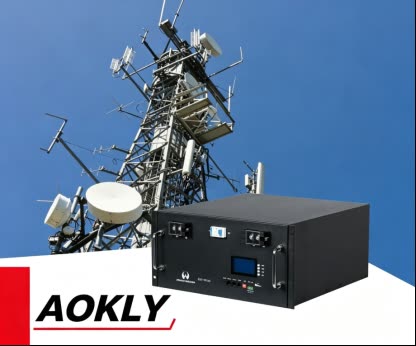
These stackable units follow standard 19-inch rack dimensions. Telecom operators can install them directly into existing cabinet infrastructure without structural modification. Parallel connection supports capacity expansion as load demand grows. A single rack can house multiple modules, scaling from 4.8 kWh to beyond 30 kWh depending on configuration.
AOKLY GROUP also produces all-in-one (AIO) energy storage machines. These combine the inverter, BMS, lithium battery pack, and monitoring interface in a single enclosure. AIO systems reduce installation complexity for residential and small commercial users. They arrive pre-configured, which shortens commissioning time from days to hours.
Alongside its lithium ion battery lineup, AOKLY has introduced sodium-ion modules. Sodium cells perform better than LFP at temperatures below minus 20 degrees Celsius. They also avoid reliance on lithium carbonate pricing. However, sodium-ion energy density remains lower than LFP, and cycle life is shorter at present. AOKLY positions sodium-ion products for cost-sensitive off-grid installations in cold climates — not as a universal replacement for lithium.
A Neutral Assessment of Green Energy Performance
1. Strengths of LFP Chemistry
LFP cathodes contain no cobalt, which reduces both raw material cost and supply-chain ethical concerns. Thermal runaway thresholds sit higher than those of nickel-manganese-cobalt (NMC) alternatives.
This inherent thermal stability lowers the engineering burden on pack-level safety systems. Energy density at the cell level reaches approximately 160 Wh/kg — moderate compared to NMC but sufficient for stationary storage where volume constraints are less strict than in electric vehicles.
2. BMS Contribution to System Reliability
The BMS in AOKLY modules monitors individual cell voltages and temperatures in real time. Active balancing redistributes charge among cells during both charging and idle states. This prevents capacity fade caused by cell-to-cell imbalance. Over-charge protection triggers a relay disconnect before any cell exceeds safe voltage limits.
These functions collectively raise system available uptime, which matters in telecom backup where service-level agreements impose strict downtime penalties.
3. Honest Cost Comparison with Lead-Acid
A lithium ion battery pack costs roughly two to three times more than a lead-acid equivalent at the point of purchase. However, lead-acid batteries typically deliver 300 to 500 cycles before reaching end-of-life. LFP packs from AOKLY are rated for over 4,000 cycles.
When total cost of ownership (TCO) is calculated on a per-cycle or per-kWh-delivered basis, LFP often reaches parity or lower cost within three to five years. Lead-acid also requires periodic water refilling and generates hydrogen gas during charging, adding maintenance labor and ventilation requirements.
Lithium packs are sealed and maintenance-free in normal operation. Still, for applications requiring fewer than 200 annual cycles, lead-acid may remain economically justified. The decision depends on specific project parameters rather than blanket superiority claims.
Application Boundaries and Selection Guidance
Household system sizing starts with daily energy consumption. A home consuming 10 kWh per day typically needs a battery rated at 12 to 15 kWh to allow for cloudy-day reserves and depth-of-discharge limits. AOKLY’s 48V-100Ah modules provide 4.8 kWh each.
Three units in parallel deliver 14.4 kWh — adequate for this example with reasonable headroom. The AIO systems offer a simpler path for homeowners who prefer a single-box solution without separate inverter selection.
Telecom sites standardize around 48V DC bus architecture. AOKLY’s rack-mount modules fit directly into standard telecom cabinets. Backup duration depends on site load. A base station drawing 3 kW requires a 48V-200Ah system (9.6 kWh) for approximately three hours of autonomy.
Multiple racks extend this duration linearly. The key specification to verify is the continuous discharge rate. Telecom loads are relatively steady, so 0.5C discharge capability suffices in most cases.
Industrial facilities face demand charges based on peak power draw. A lithium storage system charges during off-peak hours and discharges during peak tariff windows. Sizing requires analysis of the facility’s load profile, peak-to-average ratio, and local tariff structure.
AOKLY’s 48V-200Ah modules can be assembled into large arrays. However, industrial applications often demand discharge rates above 1C during short peaks. Confirming that the chosen module supports the required C-rate without voiding warranty coverage is essential before procurement.
Northern regions with winter temperatures consistently below minus 10 degrees Celsius present challenges for LFP cells. Capacity drops and internal resistance rises in cold conditions. Sodium-ion cells from Guangdong Aokly Group Co.,Ltd maintain better discharge performance in these environments.
They suit off-grid rural electrification projects where heating the battery enclosure is impractical. Sodium-ion is not promoted as the sole solution for all climates or all budgets. It serves as a targeted complement within a broader product toolkit.
Conclusion
Selecting a lithium ion battery manufacturer for green energy projects involves matching product specifications to site-specific load profiles, environmental conditions, and lifecycle cost targets. AOKLY GROUP offers a structured product range — from compact 12V modules to scalable 48V rack systems and integrated AIO units — that addresses residential, telecom, and industrial segments.
The parallel availability of sodium-ion products adds a cold-climate option without forcing a single-chemistry approach. Traceable manufacturing processes and international certification provide a verification baseline for procurement teams.
Project planners evaluating lithium storage options can request detailed specification sheets, BMS communication protocols, and reference installation data through the company portal. For technical documentation and product inquiries, visit: https://www.aokly-battery.com/
FAQ
Q1: What is the typical cycle life of AOKLY LFP lithium battery modules?
AOKLY LFP modules are rated for over 4,000 cycles at 80% depth of discharge. Actual cycle life varies based on ambient temperature, charge rate, and discharge depth in specific installations.
Q2: Can AOKLY 48V modules fit into existing telecom cabinets without modification?
Yes. The 48V stackable modules follow standard 19-inch rack dimensions. They install directly into conventional telecom battery cabinets, allowing operators to replace lead-acid units without cabinet redesign.
Q3: When should sodium-ion batteries be chosen over lithium iron phosphate?
Sodium-ion cells suit environments with sustained temperatures below minus 10 degrees Celsius, or projects where lithium carbonate price volatility creates budget uncertainty. They are not a direct replacement for LFP in standard temperature ranges.
Q4: What certifications does Guangdong Aokly Group Co.,Ltd hold for its manufacturing processes?
The company maintains ISO 9001 quality management, ISO 14001 environmental management, and IATF 16949 automotive quality system certifications. Products carry relevant regional certifications depending on destination market requirements.
Q5: How does AOKLY support capacity expansion after initial installation?
The modular design of 48V systems allows parallel connection of additional units. Capacity scales linearly by adding modules to existing racks. The BMS architecture supports communication between multiple parallel packs without requiring full system reconfiguration.
Tags :lithium ion battery manufacturerLFP batterysodium-ion batterysolar storage batterytelecom backup batteryenergy storage system48V rack batteryChina battery manufacturer
AOKLY GROUP
AOKLY GROUP
Legal Disclaimer:
EIN Presswire provides this news content “as is” without warranty of any kind. We do not accept any responsibility or liability
for the accuracy, content, images, videos, licenses, completeness, legality, or reliability of the information contained in this
article. If you have any complaints or copyright issues related to this article, kindly contact the author above.

Media gallery