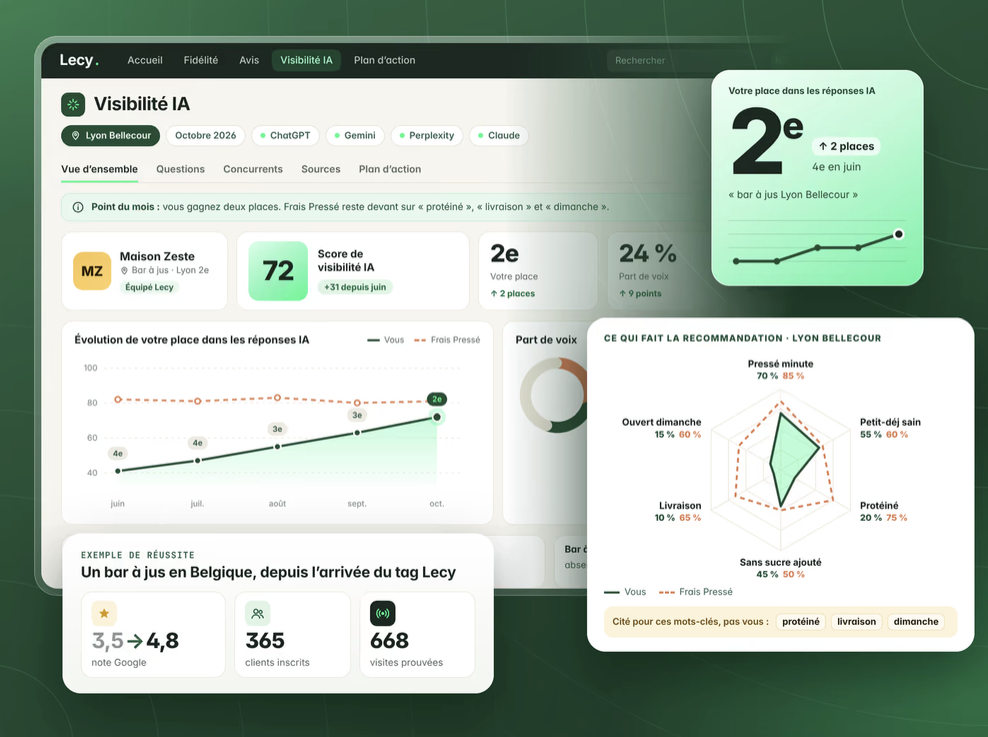
One NFC tag at the till, four AI assistants asked every month, a score per shop and an AI agent that prepares every action for the merchant’s approval.
PARIS, FRANCE, October 19, 2026 /EINPresswire.com/ — Lecy, publisher of the loyalty tag that counts a visit with one tap of the customer’s phone, today announces the launch of AI Visibility, a module that measures what ChatGPT, Gemini, Perplexity, Claude and Google Maps answer when customers ask where to go, and prepares the actions that make a shop the answer. It is available now as the Complete + AI Visibility plan at 99 euros per month per point of sale, a launch price, and as a per-site option for franchise networks.
Three 2026 studies document the shift. BrightLocal’s Local Consumer Review Survey 2026: the share of US consumers who asked an AI to recommend a local business rose from 6% to 45% in a year, and 74% want reviews from the last three months. SOCi’s Local Visibility Index 2026, about 350,000 locations: 35.9% reach Google’s local top three, 11% are recommended by Gemini and 1.2% by ChatGPT, so an AI recommendation is three to thirty times harder than a Google ranking. In France, an IFOP study for Guest Suite finds that 93% of consumers read reviews before choosing a business and 48% distrust a review that is two years old.
The loop: from the tap at the till to the AI’s answer
Lecy’s starting point is a dynamic NFC tag placed next to the till. The customer holds their phone to it, opens the link, and earns a point: one visit, one point, with no app, no card, no account and nothing for the team to do. Each tap opens a unique, encrypted, single-use link, a proof that the customer was physically there. After the point, the customer is asked how the visit went. A mixed answer goes privately to the manager; a positive one is invited to Google in one tap. The result is a flow of recent reviews tied to real visits, at the pace of the shop’s traffic.
AI Visibility closes the loop. A good rating and recent reviews weigh heavily in AI answers, and every visit can now produce one. Where AI visibility tracking tools measure how often a brand is cited, Lecy measures and supplies the material the engines read: reviews collected at each visit through the tag, a complete Google profile, and texts prepared for the merchant. New customers find the shop through the assistant, come in, tap the tag, and the loop starts again.
Seven modules, one score
1. Visibility. Ten customer questions, city by city, asked to ChatGPT, Gemini, Perplexity and Claude separately, plus Google Maps. The shop is compared with its three nearest competitors.
2. Competitors. Six criteria that drive recommendations, compared criterion by criterion, with the keywords competitors are cited for and the shop is not.
3. Corrections. When an AI gets the shop wrong or ignores it, the module flags the error, traces it to its source and prepares a correction for approval.
4. Proximity. The same question asked from nine points around the shop, with Google Maps and Gemini side by side, to see street by street where a competitor takes the shop’s place.
5. Trends. Rising requests city by city, keywords a neighbour is cited for, and a post drafted by the agent.
6. AI agent. Every action is ranked by the points it can earn; replies to reviews, posts and profile texts are prepared; the merchant approves.
7. Network. A score per shop and per city, lagging shops listed first, and a monthly report for the head office.
Built to stay simple
Nothing to connect: the module reads public information only, with nothing to install. The merchant approves everything: Lecy prepares, the shop publishes. Four AIs plus Google Maps are asked the same questions every month, city by city. No integration and no commitment: the tag at the till is all it takes.
“Tracking tools tell a shop how invisible it is. That is useful, and it is not enough. The thing AI assistants read most is a steady flow of recent reviews from people who were actually there, and that is what one tag at the till produces every day. AI Visibility turns that flow into a score, a list of actions and texts ready to approve,” said Badr El Moujtahid, founder of Lecy.
For franchise networks
Networks already use Lecy’s cockpit to compare outlets on measured visits rather than declared figures. AI Visibility adds a recommendation score per shop and per city, lists the lagging shops first and sends the head office one report a month. For networks, the module is priced per site and by volume, on top of the franchise and network plan that puts the Complete plan in every outlet from 35 euros per site per month.
Availability and pricing
AI Visibility is available now in France, Belgium and Croatia, where Lecy is deployed. It is sold with the Complete plan as Complete + AI Visibility at 99 euros per month per point of sale, or 990 euros a year with two months free, a launch price kept for as long as the subscription runs; it is not sold on its own. Every plan includes the NFC tag, delivered within days and already linked to the shop, with no commitment and no set-up, integration or training fee.
About Lecy
Lecy is built to be the simplest loyalty solution for shops and franchise networks: a dynamic NFC tag at the till, one tap per visit, no app, no card, no typing, no POS integration and nothing for the team to do. Each tap opens a unique, encrypted, single-use link, a proof that the customer was there; a mixed feeling goes privately to the manager, a positive one is invited to Google. Lecy is published by NFGO SAS, Paris, and is live in France, Belgium and Croatia. More at lecytap.com.
NFGO
Lecy
Visit us on social media:
LinkedIn
X
Legal Disclaimer:
EIN Presswire provides this news content “as is” without warranty of any kind. We do not accept any responsibility or liability
for the accuracy, content, images, videos, licenses, completeness, legality, or reliability of the information contained in this
article. If you have any complaints or copyright issues related to this article, kindly contact the author above.

Media gallery