A flat 25-point duty swing rides on the cable feeding the AI buildout — and Kestner Supply’s China–Vietnam plants let buyers elect Vietnam origin.
PRINCETON, NJ, UNITED STATES, August 25, 2026 /EINPresswire.com/ — The buildout of AI data centers is consuming cable and cordage at unprecedented scale — and a U.S. tariff structure that took effect in July 2026 now makes a component’s country of manufacture a swing of roughly 25 percentage points in landed duty.
According to Dell’Oro Group, worldwide data-center capital spending is on track to approach $1 trillion, with about two-thirds tied to AI infrastructure by 2030. Every rack in that buildout is wired: power cordage, copper patch and direct-attach cable, coaxial, and optical fiber. For a U.S. importer, the duty on that wiring now depends heavily on one variable — country of origin.
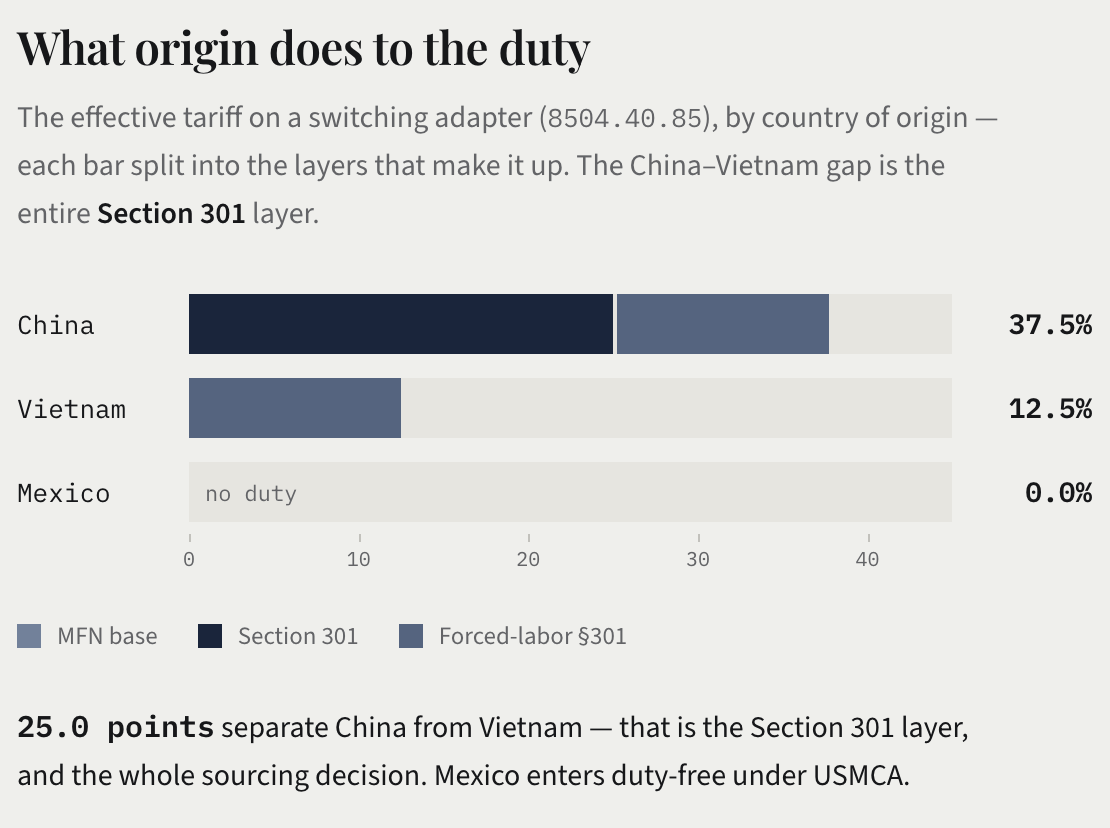
Figures published by Kestner Supply, a U.S. company that manufactures power cords, cable assemblies, and power adapters in its own plants in China and Vietnam, quantify the swing. Under the current stack — the most-favored-nation base rate, the 25 percent Section 301 List 3 duty on Chinese-origin goods, and the 12.5 percent Section 301 forced-labor duty effective July 24, 2026 — the effective U.S. duty on connectorized cable and cordage (HTS 8544.42.90) is 40.1 percent from China versus 15.1 percent from Vietnam. Coaxial cable (8544.20.00) runs 42.8 percent versus 17.8 percent; optical fiber (8544.70.00), 37.5 percent versus 12.5 percent; and power supplies (8504.40.85), 37.5 percent versus 12.5 percent.
The pattern is consistent: a flat 25-point gap between Chinese and Vietnamese origin across every category. That gap is the List 3 Section 301 duty, which applies to goods of Chinese origin only; the July forced-labor duty raised both origins by the same amount and left the gap intact. The rates are current as of the company’s July 29, 2026 verification date, and the forced-labor duty is being challenged in court.
“On the hardware wiring the AI buildout, country of origin has quietly become a 25-point line item,” said Shangye Li, founder of Kestner Supply. “For a program buying cable and cordage by the container, that is not a rounding error. It is often the difference between a project’s margin surviving contact with customs and not.”
The gap, Li noted, is only real if the origin is. “A Chinese cable finished in a third country is still Chinese origin, and customs assesses it accordingly, with penalties. The savings only clear when the manufacturing — the substantial transformation — actually happens where the paperwork says.”
That is the basis of the China-plus-one approach many procurement teams have adopted: adding a qualified non-China source to cut exposure to the China-only duty layer. Kestner builds to the same specification and test standard in both its China and Vietnam plants, so a buyer can elect Vietnam origin on the purchase order without requalifying the part.
Kestner cautioned against reading the analysis as a blanket claim on data-center infrastructure. High-speed fiber trunking and the specialized cabling of hyperscale facilities sit outside the company’s catalog; the figures are offered as a tariff analysis of the cable categories broadly, and the company’s own scope is power cords, cable assemblies, power adapters, and general connectivity hardware in its lane.
The full duty stack — every layer, every HTS code, and the source for each rate with a verification date — is published on the company’s Insights reference, alongside a landed-cost calculator that estimates per-unit duty by origin.
About Kestner Supply
Kestner Supply is a U.S. company that manufactures power and connectivity hardware — power adapters, power supplies, power cords, cable assemblies, and patch cords — in its own factories in China and Vietnam, and sources the rest to the same standard. It builds to a buyer’s specification, documents country of origin per unit, and prices in U.S. dollars with the tariff math shown. More at kestnersupply.com.
Mike Li
Kestner Supply
+1 574-216-6551
info@kestnersupply.com
Visit us on social media:
LinkedIn
Other
Legal Disclaimer:
EIN Presswire provides this news content “as is” without warranty of any kind. We do not accept any responsibility or liability
for the accuracy, content, images, videos, licenses, completeness, legality, or reliability of the information contained in this
article. If you have any complaints or copyright issues related to this article, kindly contact the author above.

Media gallery