
EverMind Launches Raven Agent: The Self-Improving Harness That Defines L3-level Digital Life
PR Newswire
SAN MATEO, Calif., July 9, 2026
First Agent Harness Built on EverOS to Feature 100,000 Evaluated Skills and Code-Level Self-Improvement, Advancing Digital Life Toward the L3 Frontier
SAN MATEO, Calif., July 9, 2026 /PRNewswire/ — EverMind, a global AI company incubated by Shanda Group and dedicated to pioneering long-term memory infrastructure for the Agent era, today announced the official launch of Raven Agent — a deeply self-evolving Agent Harness built on EverOS, its open-source memory operating system. Raven is designed to push AI agents beyond the limitations of stateless interaction and retrieval-based memory, delivering a new paradigm of proactive, personalized, and continuously self-improving intelligence.
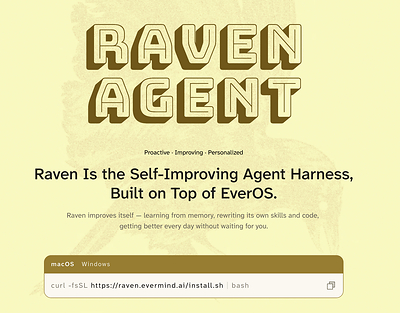
Raven’s launch marks a pivotal milestone in EverMind’s mission to define the memory architecture of the agentic future — and represents the company’s most significant step yet toward enabling what it calls L3-level Digital Life: AI agents capable of rewriting their own code, refining their own skills, and evolving through every interaction.
Despite rapid advances in large language models, the vast majority of AI systems remain fundamentally stateless — they forget everything the moment a session ends. Industry workarounds such as Retrieval-Augmented Generation (RAG) and extended context windows have improved recall, but they remain, in essence, sophisticated filing systems. The AI retrieves notes; it does not truly *remember*. EverMind draws a sharp distinction: real memory is not retrieval — it is internalization. A truly memory-capable agent does not look up that you prefer your coffee black; it has absorbed that preference into its cognitive model of you, and applies that understanding proactively, without prompting. Raven is built on this principle from the ground up.
What Makes Raven Different
Powered by EverOS’s four-layer bionic architecture — Agent Layer, Memory Layer, Index Layer, and Interface Layer — Raven transforms raw interaction streams into structured memory units, clusters them into contextual scenes, and builds a continuously updated deep profile of each user, encompassing identity, preferences, skills, and long-term goals. Three capabilities set Raven apart from every existing agent product on the market.
Bidirectional Memory Internalization. Raven does not merely log interactions — it internalizes them. Every exchange updates Raven’s cognitive model of the user, and simultaneously, Raven reflects on its own performance, identifying what worked, what failed, and how to improve. Memory flows in both directions: toward the user, and toward the agent itself.
100,000 Deeply Evaluated Skills — and Counting. Raven ships with 100,000 skills covering productivity, professional verticals, and complex multi-step workflows. These skills are not static: Raven continuously evaluates their effectiveness in real use, retiring underperforming ones, reinforcing high-value ones, and synthesizing new skill combinations from observed patterns.
Code-Level Self-Rewriting. This is Raven’s most groundbreaking capability. Raven can rewrite its own skills, runtime logic, and operational strategies. Coupled with EverBrain — EverMind’s on-device personalized model — Raven can dynamically fine-tune its own model weights. The result is an agent that does not merely respond to the world, but actively rewrites itself in response to it. Even when the user is offline, Raven continues to evolve.
The Digital Life Framework: From L2 to L3
To contextualize Raven’s significance, EverMind has articulated a four-stage framework for the evolution of digital life:
|
Level |
Classification |
Capability Profile |
|
L1 |
Role-based Functional Agent |
Instruction-following; no persistent memory |
|
L2 |
Memory-Augmented Interactive Agent |
Cross-session memory; multi-step task planning |
|
L3 |
Self-Improving Cognitive Agent |
Reinforcement learning; self-rewriting code; model fine-tuning |
|
L4 |
Autonomous Digital Life |
Full data sovereignty; proactive goal pursuit; AGI-era digital twin |
More than 90% of AI applications worldwide remain at L1 or L2. Raven is EverMind’s engineered bridge to L3 — and the foundational infrastructure for the eventual L4 transition. Beyond individual capability, Raven is architected as an open platform for the broader developer community. EverMind has designed Raven with a fully decoupled, pluggable architecture: the memory module, proactivity engine, and tool router are entirely independent, allowing developers to swap any component without touching the core framework.
Through the forthcoming Raven Builder, developers will be able to define specialized agents for any domain and share them with a single click. These agents — whether a contract law specialist trained by a legal professional, or a financial modeling expert cultivated by an investment analyst — will be discoverable, deployable, and further refinable on the EverMe platform. This creates a powerful flywheel: more agents generate more usage data; richer data makes EverOS’s memory system more precise; greater precision accelerates the evolution of the next generation of agents. The network effects, once in motion, become self-reinforcing.
The Infrastructure Behind Raven: EverOS and Academic Leadership
Raven is built on EverOS, EverMind’s open-source memory operating system, which crossed 10,000 GitHub Stars within approximately one month of its public release — a velocity that surpassed mem0’s first-seven-month star count of approximately 7,000. EverOS’s latest 1.1.0 release introduces a tripartite memory taxonomy — User Memory (defining the person), Agent Memory (defining the agent), and Knowledge Wiki (defining the world) — alongside a proprietary Reflection mechanism inspired by human contemplation, enabling agents to consolidate intelligence during idle periods.
EverMind’s academic team has simultaneously established theoretical leadership in the field, with four recent high-impact publications:
- MSA (Memory Sparse Attention): An end-to-end trainable sparse attention mechanism extending context to 100 million tokens with less than 9% performance degradation. Topped HuggingFace Daily Papers on release day.
- HyperMem: A hypergraph hierarchical memory architecture achieving 92.73% SOTA on the LoCoMo benchmark. Awarded ACL 2026 Oral Presentation.
- EverMemOS: A self-organizing memory operating system for structured long-horizon reasoning. Accepted to ACL 2026 Main Conference.
- Multi-Party Dialogue Long-Term Memory Evaluation: A benchmark filling a critical industry gap. Awarded KDD 2026 Oral Presentation.
Availability
Raven Agent is available now at [raven.evermind.ai] [https://github.com/EverMind-AI/Raven].
EverOS is open source and available on GitHub at [github.com/EverMind-AI/EverOS] and the cloud API is accessible at [https://evermind.ai/everos].
About EverMind
EverMind is a global AI company incubated by Shanda Group, dedicated to building long-term memory infrastructure for the Agent era. Backed by Shanda Group’s decades of experience at the intersection of technology and digital ecosystems, EverMind brings together world-class researchers and engineers to redefine how AI agents remember, learn, and evolve. Its full-stack ecosystem spans EverBrain (personalized memory model), EverOS (opensource and cloud-based memory operating system and agent infrastructure), Raven (self-improving Agent Harness), and EverMe (personal memory hub and digital life management platform).
For more information, visit [evermind.ai]
 View original content to download multimedia:https://www.prnewswire.com/news-releases/evermind-launches-raven-agent-the-self-improving-harness-that-defines-l3-level-digital-life-302822003.html
SOURCE EverMind


