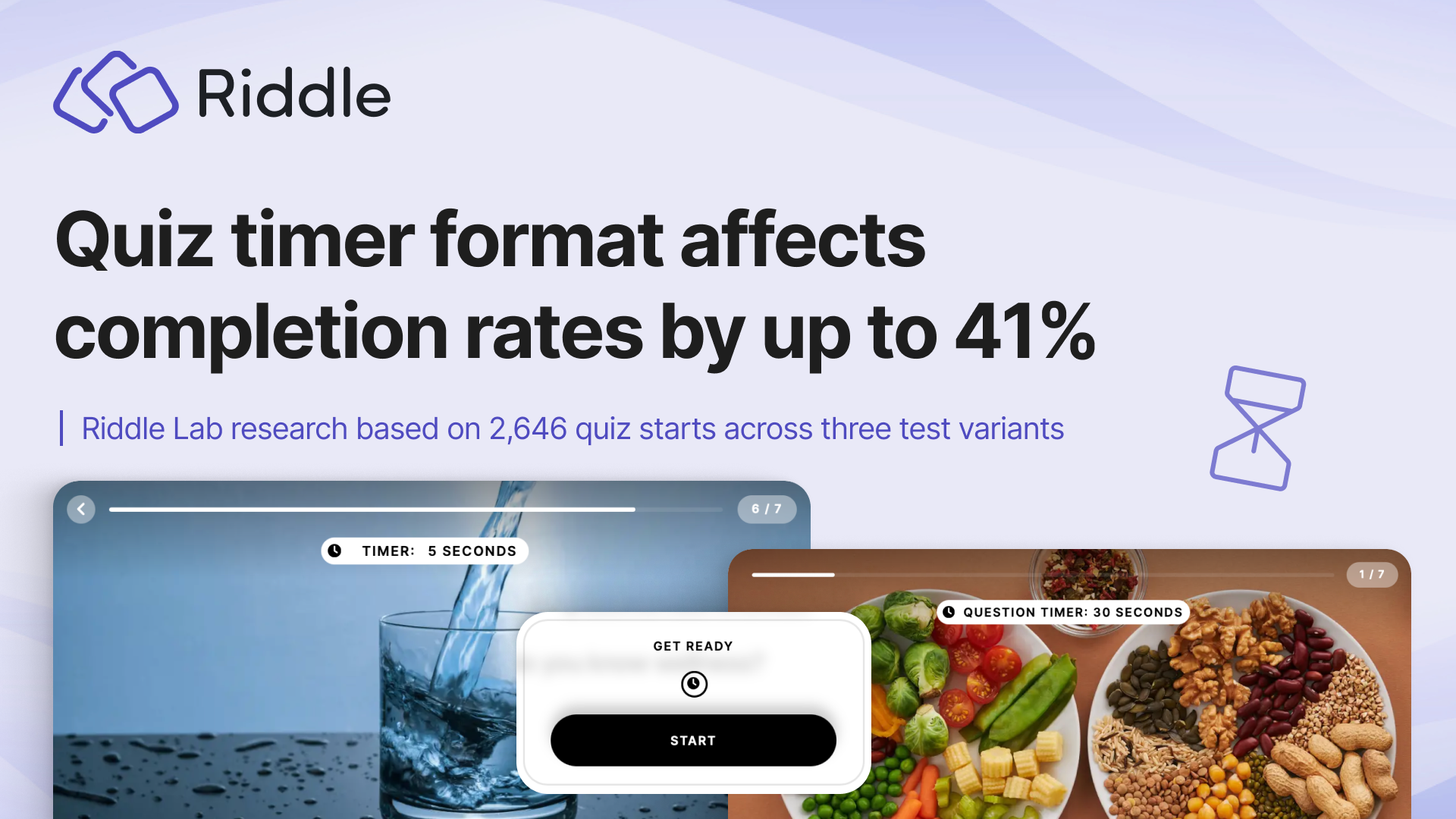
Riddle Lab tested 2,646 quiz starts across three identical quizzes. The only difference was the timer – and it lifted completions 41% and dwell time 32%.
SAARBRUECKEN, SAARLAND, GERMANY, August 12, 2026 /EINPresswire.com/ — One small change can make a big difference to quiz engagement: adding a countdown timer. New research from Riddle Lab, the research arm of interactive content platform Riddle.com, puts that difference at 41% more completions – from a setting most editorial teams never touch.
In a controlled study of 2,646 quiz starts, a per-question timer lifted completions from 36.8% to 52.1% and increased dwell time by 32%, compared with the same quiz run with no timer at all.
THE FINDINGS: Riddle Lab published one quiz – “Do You Know the World’s Most Iconic Landmarks?” – three separate times. Same seven questions, same answer options, same result pages, same timeframe, same audience mix. The only variable was the timer setting.
THE RESULTS:
– Per-question (block) timer: 52.1% completion – 537 of 1,030 starts
– No timer: 36.8% completion – 317 of 861 starts
– Single quiz-wide timer: 40.4% completion – 305 of 755 starts
Dwell time followed the same pattern. Players using the per-question timer stayed 68.4 seconds on average, against 51.9 seconds with no timer – a 32% increase. The quiz-wide countdown performed worst of the three at 44.2 seconds.
The most counter-intuitive result concerns failure. Nearly four in ten players – 38% – had the clock run out on at least one question, the moment most publishers would expect readers to abandon a quiz. That version still finished 15 percentage points ahead of the one with no timer.
WHY THE PER-QUESTION TIMER WINS
“Publishers leave timers off to be kind to the reader,” said Boris Pfeiffer, CEO and founder of Riddle.com. “The data says the opposite. A short countdown on each question builds momentum. One long countdown feels like an exam, and people leave. Ten seconds to switch on, 41% more completions.”
The difference between the two timers is the reset. A per-question timer starts fresh at every question, so each one is a short challenge the reader can win. A quiz-wide timer only counts down – the further a reader gets, the less time remains, which is the opposite of momentum.
Based on the study, Riddle Lab recommends publishers:
– Make the per-question timer the default on editorial quizzes
– Reserve quiz-wide timers for genuine speed-challenge formats
– Stop treating no-timer quizzes as the reader-friendly option
– Front-load easier questions in the opening third of the quiz, where drop-off concentrates
METHODOLOGY
The study covered 2,646 quiz starts across three identical versions of one quiz, distributed across the same timeframe to a predominantly mobile audience in the United States, United Kingdom, India and the Philippines. Completion was measured as finishers divided by starts. Retention was tracked question by question, and time measured as total session duration alongside active time on page.
Full findings, per-question retention curves and the underlying data are available at:
https://www.riddle.com/blog/lab/quiz-timer-dwell-time-completion-rate/
About Riddle.com
Riddle.com is a quiz maker used by publishers, broadcasters and brands to create quizzes, polls, personality tests, forms, predictors and micro-games without writing code. Riddle content is fully brandable, GDPR-compliant, and embeds directly into any CMS. Riddle also offers AI-assisted creation, letting editorial teams generate a quiz or poll from the URL of an existing article in seconds.
Kathrin Müller
Cookie Communications GmbH
+49 40 286686117
email us here
Visit us on social media:
LinkedIn
Instagram
Facebook
YouTube
TikTok
X
Legal Disclaimer:
EIN Presswire provides this news content “as is” without warranty of any kind. We do not accept any responsibility or liability
for the accuracy, content, images, videos, licenses, completeness, legality, or reliability of the information contained in this
article. If you have any complaints or copyright issues related to this article, kindly contact the author above.

Media gallery